
ISSN: 2007-462X
UNIVERSIDAD AUTÓNOMA DE NAYARIT UNIDAD ACADÉMICA DE ODONTOLOGÍA DIRECCIÓN DE POSGRADOS
NÚMEROS
ACERCA DE
Comparación de las propiedades de las cadenas elastoméricas grises y transparentes.

Resumen
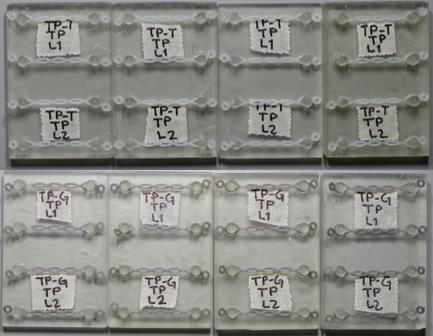
Las cadenas elastoméricas se utilizan para aplicar fuerzas ligeras y continuas en ortodoncia. Una de sus desventajas es la pérdida de sus propiedades elásticas después de un tiempo corto de uso, provocando movimientos dentales ineficientes. La adición de pigmentos a las cadenas modifica la estructura molecular del material, afectando la capacidad de resistencia a la tracción a lo largo del tiempo. Objetivo: Comparar la fuerza, longitud y modulo elástico de las cadenas elastoméricas grises y transparentes. Materiales y métodos: Se realizó un estudio in vitro con una muestra de 72 segmentos de cadena color gris y 72 transparente, divididas en 6 grupos de tiempo. Se fabricaron 36 plantillas con 20 mm de separación, para sujetar las cadenas a una longitud constante; se sumergieron en saliva artificial, alojadas en una incubadora a 37°C. La fuerza se midió con un dinamómetro y la longitud con un calibrador vernier digital y el módulo elástico con una maquina instron 5507. Se realizaron pruebas de t de Student, ANOVA y post hoc de Tukey. Resultados: El promedio de la fuerza inicial de las cadenas grises fue menor que las transparentes y a los 28 días las grises tuvieron una pérdida de fuerza mayor (42%) y las transparentes del 36.1%. Las cadenas grises tuvieron mayores cambios dimensionales (39.2%) y las transparentes el 27.8% de su longitud inicial y la disminución del módulo elástico también fue mayor en las grises (35.8%) mientras que las transparentes disminuyo el 26.7%. En la prueba estadística de t de Student en el módulo elástico se encontraron diferencias estadísticas significativas del inicio hasta los 7 días. En la fuerza solamente se encontraron diferencias estadísticas significativas al inicio y en la longitud a las 24 horas.
Palabras clave: Cadenas elastoméricas, ortodoncia, grises, transparentes.
Abstract
Elastomeric chains are used to apply light, continuous forces in orthodontics. One of their disadvantages is the loss of their elastic properties after a short period of use, causing inefficient tooth movement. The addition of pigments to the chains modifies the molecular structure of the material, affecting the tensile strength over time. Objective: To compare the strength, length, and elastic modulus of gray and transparent elastomeric chains. Materials and methods: An in vitro study was conducted with a sample of 72 gray and 72 transparent chain segments, divided into 6 time groups. Thirty six templates were manufactured, spaced 20 mm apart, to hold the chains at a constant length; they were immersed in artificial saliva and housed in an incubator at 37°C. Strength was measured with a dynamometer, length with a digital vernier caliper, and elastic modulus with an Instron 5507 machine. Student’s t test, ANOVA, and Tukey’s post hoc tests were performed. Results: The average initial strength of the gray chains was lower than the transparent ones, and at 28 days, the gray chains had a greater loss of strength (42%) and the transparent ones, 36.1%. The gray chains showed greater dimensional changes (39.2%), and the transparent ones 27.8% of their initial length. The decrease in elastic modulus was also greater in the gray chains (35.8%), while the transparent ones decreased by 26.7%. The Student’s t test found statistically significant differences in elastic modulus from the beginning to the 7th day. Significant differences in strength were only found at the beginning and in length at 24 hours.
Keywords: elastomeric chains, orthodontic, gray, transparent.